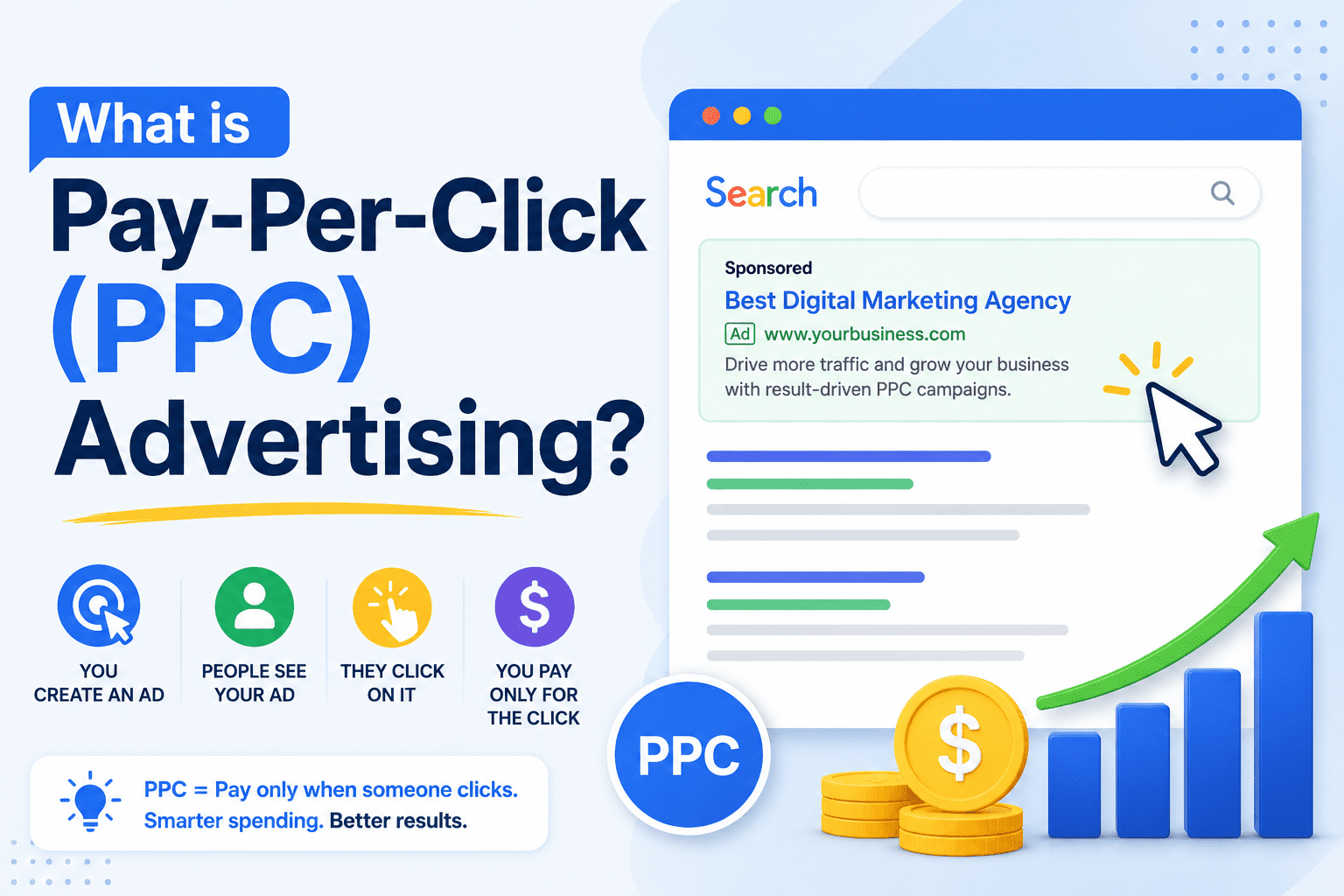
Pay-Per-Click (PPC) is an online advertising model where businesses pay only when users click their ads.
This model differs from organic marketing methods, which require time to gain traction, as PPC delivers instant visibility. As soon as your campaign begins, your business can appear at the top of search results.
This makes PPC particularly effective for service-based companies that need steady leads in a timely manner.
Instead of waiting months to rank organically on Google, PPC helps your business appear instantly in relevant search results.
It places your ads before users actively searching for products or services, increasing visibility and driving targeted traffic.
Some of the most commonly used PPC platforms are:
Google Ads
LinkedIn Ads
Meta Ads (which includes Facebook and Instagram)
Microsoft Advertising (also known as Bing Ads)
Selecting the appropriate platform depends on where your target audience is most active and how they look for solutions.
How PPC Works
PPC advertising is based on a real-time bidding system. Whenever a user performs a search, platforms like Google Ads quickly assess all advertisers who are competing for that search term and decide which ads to display.
This process takes place in just a few milliseconds, but several factors play a role in determining which ads get shown.
PPC runs on a bidding system.
When a searcher types in a query:
Advertisers place bids on specific keywords (e.g., “digital marketing agency Newyork california”)
The platform looks at these bids and the quality of the ads
The most relevant and effective ads appear at the top of the search results
Important factors that affect performance include:
Bid Amount – How much you’re willing to pay for each click
Quality Score – How relevant your ad, keywords, and landing page are
Ad Rank – Where your ad will be placed in the search results
Benefits of PPC Advertising
One of the main advantages of PPC is speed.
As soon as your campaign is live, your ads can start appearing to potential customers. This is especially beneficial for new businesses, promotions, or urgent offers where waiting for SEO results isn’t feasible.
Precise Targeting
PPC gives you the ability to target your audience very accurately.
You can choose to show your ads to users based on:
Location (e.g., NewYork, California)
Device type
Demographics
Interests and behaviors
Trackable Results
Every part of a PPC campaign can be measured.
You can track impressions, clicks, conversions, and revenue. Using tools like Google Analytics, you can see what’s working and what isn’t, allowing you to make improvements and make informed decisions.
Every click, impression, and conversion can be tracked, enabling real-time campaign optimizations.
Easily Scalable
Once you find a campaign that consistently produces leads or sales, it’s easy to scale.
By increasing your budget and expanding the list of targeted keywords, you can grow your results in a predictable way without changing your overall strategy.
Types of PPC Ads
Search Ads
Search ads are text-based advertisements that show up at the top of search engine results when users search for certain keywords.
These ads are effective because they reach users who are actively looking for something, often leading to a higher chance of conversion.
Text ads that appear on search engines when users search for specific keywords.
Display Ads
Display ads are visual banners that appear on websites within a network.
While they may not always reflect direct intent, they are great for brand awareness and keeping your brand in front of potential customers as they browse.
Visual banner ads that appear on websites across a network.
Social Media Ads
Platforms like Facebook and Instagram allow businesses to target users based on interests, behaviors, and engagement.
These ads are ideal for brand awareness and helping customers discover your business.
Remarketing Ads
Remarketing ads are shown to users who have previously visited your website or seen your ads.
These users are already familiar with your brand, making them more likely to convert, which makes remarketing one of the most effective strategies in PPC.
How to Build a High-Converting PPC Campaign
Keyword Research
Focusing on high-intent searches ensures your budget is used on users who are ready to take action.
Examples of high-intent keywords:
“Buy”
“Best”
“Near me”
“[Service] in [city]”
Examples:
“PPC agency newyork”
“Google Ads management services”
Create Strong Ad Copy
Good ad copy can greatly improve your click-through rate and overall campaign success.
Effective ads clearly address a problem, provide a solution, and include a strong call to action.
Your ads should:
Solve a problem
Offer a benefit
Include a clear call to action
Example:
“Struggling to get leads?
Get a free PPC audit and start generating qualified traffic today.”
Optimize Landing Pages
Getting a click is just the beginning.
Your landing page must convert that visitor into a lead or customer. A well-optimized landing page matches the message of the ad, loads quickly, and makes it easy for users to take action.
Your landing page should:
Match the ad’s message
Load quickly
Include a clear call to action
Be mobile-friendly
Even small improvements in landing page performance can significantly increase your return on investment.
Set a Smart Budget
Starting with a test budget allows you to collect data and determine what works before increasing your spend.
Instead of just focusing on cost, you should assess performance using metrics like cost per click (CPC), conversion rate, and cost per acquisition (CPA). The goal is to manage your budget in a way that is both efficient and profitable.
Track and Optimize
Over time, these improvements lead to better results and lower costs.
Use tools like:
Google Analytics
Conversion tracking within ad platforms
Continuously:
Pause underperforming keywords
Test new ad variations
Improve landing page conversions
Common PPC Mistakes to Avoid
Many businesses end up wasting money on PPC because they neglect essential fundamentals.
Avoid these common mistakes:
Choosing too broad or irrelevant keywords
Sending traffic to the homepage instead of a dedicated landing page
Ignoring negative keywords
Not tracking conversions
Setting up campaigns and forgetting about them.