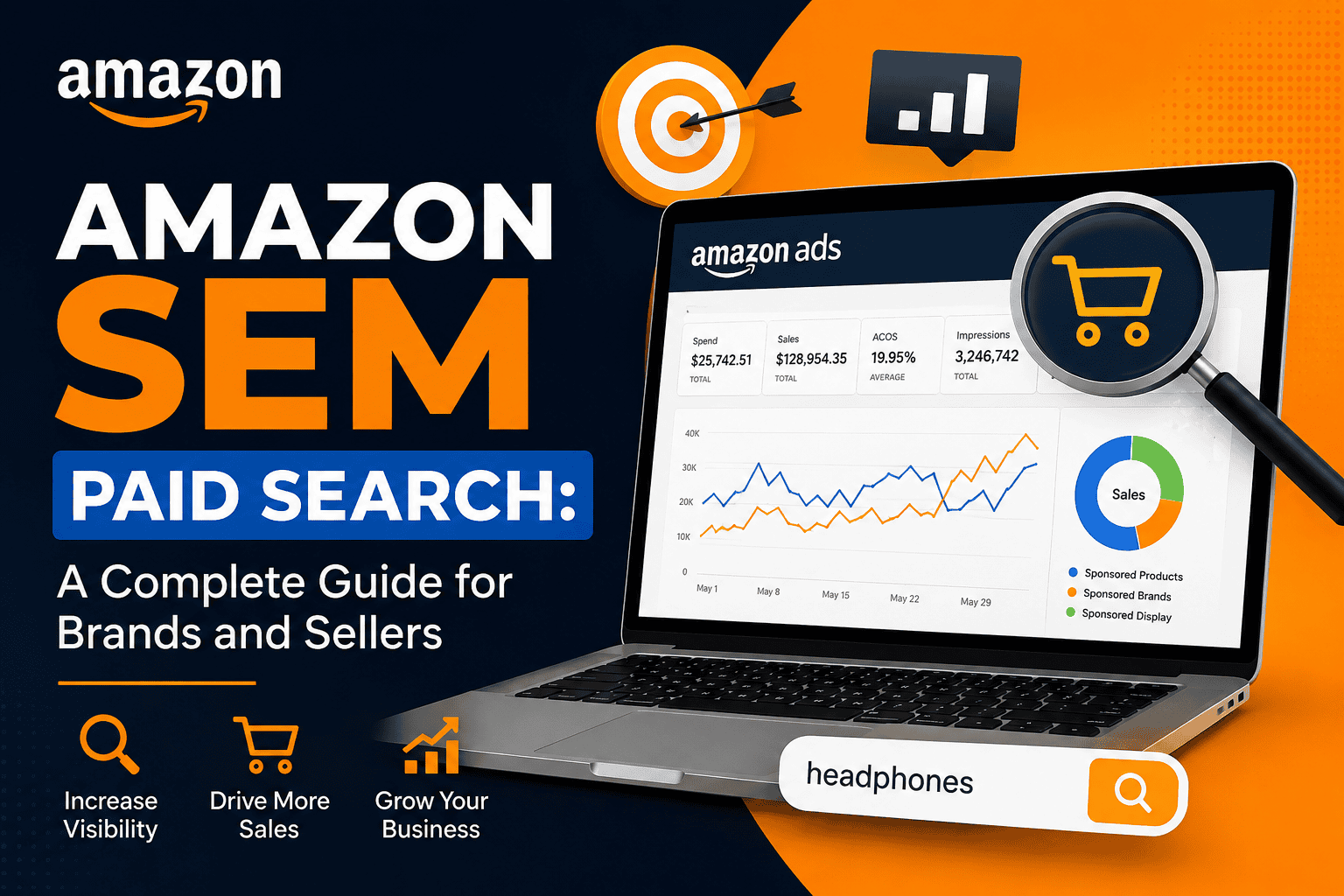
Paid search is a must if you sell things on Amazon. It's the fastest way to reach shoppers who are already looking and have their wallets out. This article explains what Amazon SEM (search engine marketing) is and how it's different from Google AdWords. It also talks about how to set up programs that can grow and how to tell if the money you spend is actually making you money.
What is Amazon SEM?
Amazon defines it succinctly: SEM, or Search Engine Marketing, is a form of paid advertising that ensures that your brand's products or services are visible in search engine results. In general, search engine marketing is a digital marketing strategy that advertisers employ to enhance the visibility of their brand, website, or product in search engine results pages. On Amazon, this entails your Sponsored Products, Sponsored Brands, and Sponsored Display ads competing for placement against every other seller bidding on the same shopper intent.
Paid search marketing is a strategy in which advertisers pay a fee each time one of their ads is clicked, resulting in a prominent appearance above or alongside organic results. This strategy provides a business with immediate visibility to individuals who are actively searching for their products. The fundamental mechanic is the same as that that powers Google Ads. On Amazon, "actively searching" refers to an individual who has already made a decision to purchase an item in that category and is in the process of entering a query into the search bar, with a purchase being just a click or two away. This is the exact reason why Amazon SEM tends to convert at a different rate than search ads in any other location.
Amazon SEM vs. Google SEM: not the same game
It's easy to think of Amazon Ads as just another paid search channel to handle along with Google, but the long-term goal is different. Amazon Ads reach shoppers who are already on Amazon, while Google Ads reach people earlier when they're looking for products without specifying a platform. You can catch that early-stage buyer with a well-run Google Shopping or search campaign and send them where your margins are highest, whether that's your own Shopify store or back to Amazon for the trust and ease of one-click checkout.
So, the two groups aren't really going up against each other; they're just working on different issues. Amazon SEM is a share-of-shelf tool in a market where 90% of people have already decided to buy. Google paid search is a demand-capture and channel-routing tool.
Why Amazon SEM has changed in 2026
The biggest shift brands need to understand right now is that Amazon's ad targeting is no longer purely keyword-matching. Amazon's AI system now prioritizes semantic understanding over simple keywords, which means brands need to revamp product content to update product detail pages with clear answers to customer questions and highlight specific features.
Practically, this means your Amazon SEM performance is now tied more tightly to your listing quality than it used to be. A campaign can be bid perfectly and still underperform if the product detail page doesn't semantically match what the algorithm believes the shopper is really asking for. Before increasing bids on underperforming keywords, audit the listing itself — title, bullet points, A+ content, and Q&A for whether it actually answers the question behind the search term.
Building a campaign structure that scales
A common and effective approach is a three-stage funnel inside your own account:
1. Discovery. Run broad and auto-targeting campaigns to let Amazon's algorithm surface search terms you wouldn't have thought to bid on directly. This stage is about data collection, not efficiency — expect a wider range of ACOS (advertising cost of sale) here.
2. Validation. Once a search term shows consistent conversions in discovery campaigns, move it into more tightly controlled phrase-match campaigns to confirm performance holds outside the auto-targeting environment.
3. Scale. The real optimization happens here: (cite index="15-1">move high-performing search terms into exact-match campaigns, and add negative keywords to discovery campaigns so your own winning terms stop competing against themselves</cite> for the same impression.
This structure prevents the single most common Amazon SEM mistake — letting broad and exact campaigns bid against each other for the same query, which quietly inflates your cost-per-click without adding incremental sales.
Know your real break-even ACOS before you set a target
It's common for sellers to choose an ACOS goal based on what "feels" competitive instead of what their margins can handle. This is how campaigns that look like they're making money quietly lose it. After you know how much your product costs, do the math backward:
Your contribution margin is the amount left over after you take out Amazon's referral and FBA fees, as well as any other variable costs like inserts or prep. Your break-even point is found by dividing that donation margin by the price at which you sell your item. Next, set your target ACOS below the level at which you break even. For example, if the level at which you break even is 38.3%, a safer operating target might be 24/7 to 32.
This step is more important than any other way of bidding. One agency guide says it straight out: a campaign that's trying to hit a 25% ACOS goal for a product that really only breaks even at 18% can't be fixed with bid tricks. If the unit economics don't support the ad spend, better bidding won't help. Only a change in price or cost will.
Budgeting: test, scale, and always-on
Rather than setting one daily budget and hoping for the best, split your Amazon ad spend into three functional pools:
- Test budget small, dedicated spend for new products, new keywords, or new campaign types where you're still gathering data.
- Scale budget the larger share of spend, directed at campaigns and search terms with proven, validated performance.
- Always-on budget You should always spend the same amount of money on branded terms and core keywords that convert well. This is because Amazon ad budgets are usually managed on a daily basis, which works well for most sellers since search demand changes every day.
This split keeps your account from drifting into reactive, day-to-day bid tweaking and gives you a framework for where new spend should go as it becomes available.
A quick troubleshooting checklist
When a campaign underperforms, work through these in order before touching your bids:
- Campaign status : confirm the campaign, ad group, and individual ads are all active and approved, not sitting in review or disapproved.
- Buy Box and eligibility: no Buy Box usually means weak or nonexistent ad delivery, regardless of bid.
- Bids : if impressions are near zero, your bid may simply be below the market's clearing rate for that placement.
- Budget : a campaign that exhausts its daily budget early in the day will show stalled clicks and lost impression share for the rest of it.
- Relevance: poor keyword-to-listing fit reduces both delivery and click-through rate, tying back to the semantic-content point above.
- Creative and pricing: disapprovals often trace back to unsupported claims or promotional language, and pricing that's out of line with competitors will suppress conversion even when the ad delivers fine.
The bottom line
In 2026, Amazon SEM will credit brands that see it as two separate but related fields: campaign structure and bidding on the one hand, and listing content quality on the other. Because of AI-driven change toward semantic matching, a strong ad account with a weak listing will not do as well as an average ad account with a listing that answers the shopper's question. Before you set goals, make sure you understand the break-even ACOS math. Set up your campaigns so that winning terms move from discovery to exact match, and look over your product content with the same level of care you use for your bids.
Need help checking your Amazon SEM account or setting up a program that will make money as it grows? agencomatic can help you find and fix places where spending is going wrong.