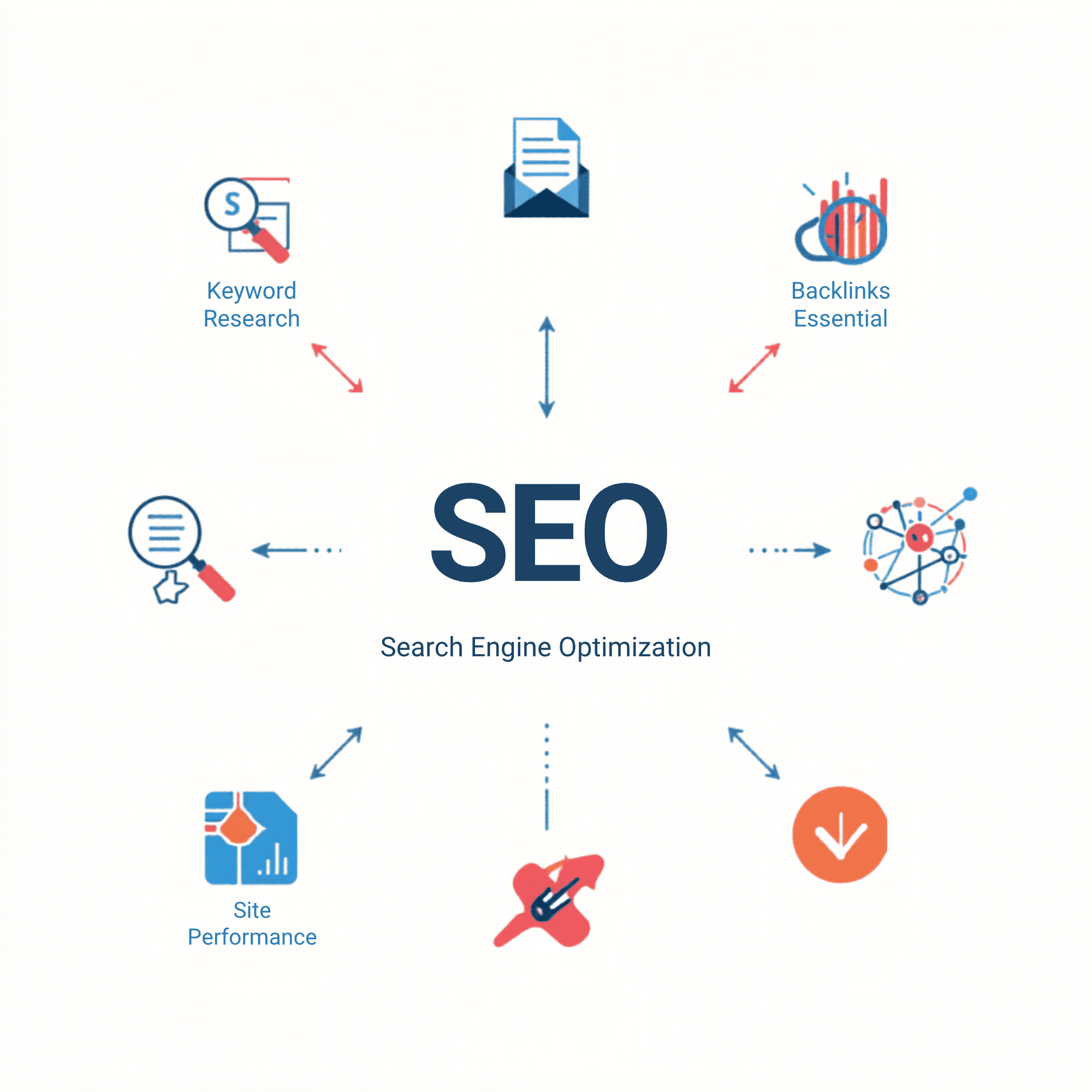
Search Engine Optimization
Get a head start on understanding SEO fundamentals like how it works, why it matters, the various kinds of SEO.
SEO, or Search Engine Optimization, helps search engines understand your website’s content and connect it with users effectively online today.
It provides pertinent and beneficial results by matching relevant website information to user queries based on search intent and relevance.
The objective of SEO is securing first-page rankings on search engine results pages for keywords most relevant to audiences.
This helps attract qualified traffic to your website by targeting valuable search terms aligned with your audience’s needs.
SEO is regarded as a digital marketing strategy applicable to any website. It enhances a website's exposure on search engines such as Google and Microsoft Bing.
Enhanced visibility of your sites in search results increases the visitors.
This introduction tutorial will elucidate the concept of SEO and its components in 2026.
Technology is ever advancing, resulting in the evolution of websites and their structural frameworks. The devices utilized to access search engines also do so.
A web search can start with voice, while a click may simply mean tapping a mobile device screen.
The outcomes from our preferred search engine may be synthesized by artificial intelligence (AI).
We shall elucidate several facets of SEO and furnish resources for your ongoing education.
What distinguishes SEO from SEM and PPC?
SEM and PPC are two prevalent terms frequently encountered on Search Engine Land and across the broader search marketing community.
It is also beneficial to differentiate SEO from its non-essentials.
This section covers terms, meanings, and applications across fields.
Search Engine Optimization versus Search Engine Marketing.
SEM denotes search engine marketing, more generally referred to as search marketing.Search marketing constitutes a category of digital marketing. It combines SEO and PPC to generate traffic from organic and paid search.
What are the distinctions between SEO and SEM?
Technically, they are not distinct; SEO constitutes merely one component of SEM.
SEO: Generating organic click-throughs from search engines.
SEM: Generating organic and paid click-throughs from search engines.
PPC: Generating paid click-throughs from search engines.
The optimal approach to comprehend SEM, SEO, and PPC is as follows:
Envision SEM as a coin. SEO is one facet of the duality. PPC is on the contrary.
Search Engine Optimization versus Pay-Per-Click
PPC, or pay-per-click, is a form of digital marketing in which marketers incur charges each time one of their advertisements is clicked.
Advertisers place bids on particular keywords or phrases for which they desire their advertisements to be displayed in search engine results.
When a person queries one of those keywords or phrases, the advertiser's advertisement (paid listing) will be displayed among the foremost results.
Thus, if we consider search marketing as a coin, SEO and PPC represent its two facets.
In PPC, the advertiser incurs a cost when a search user clicks on their paid advertisement.
Although SEO does not include direct payment for search result listings, it is marketed as a service, and the optimization of pages and websites requires time and cost; thus, it is crucial to recognize that organic search is not "free."
There has been dispute around "SEO versus PPC" — whether channel offers greater value or superior return on investment (ROI). SEO and PPC are synergistic digital marketing strategies. Preferably, one should consistently select both options, provided the budget permits.
The phrases SEM and PPC are used interchangeably within the industry.
When we refer to "SEM," we denote both SEO (organic search) and PPC (paid search).
If you are interested in the historical context of how "SEM" became synonymous with "PPC" while excluding SEO, you may explore these articles further:
The Transformation of PPC and Paid Search into "SEM" by Wikipedia.
What is the significance of SEO?
BridgtEdge Survey
A 2019 BrightEdge survey indicates that organic search accounts for 53% of all website traffic.
Over 8.5 billion queries occur daily on Google Search, which commands 91% of the global search engine industry.
The extensive audience reach has led to projections that the global SEO sector would attain an astonishing $122.11 billion by 2028.
SEO generates tangible commercial outcomes for brands, enterprises, and organizations of all scales.
The act of searching, whether through typed, voiced, or image queries, has become instinctive for internet users globally, serving as the principal method to obtain desired information amidst billions of webpages (4.3 billion pages on the indexed web, as of September 2025).
Individuals often initiate their endeavors to travel, engage in activities, acquire knowledge, conduct research, or purchase products/services with a search.
Nonetheless, search is very fragmented, especially for consumer-intent activities. Users can conduct searches on conventional web search engines (e.g., Google, Microsoft Bing), social media platforms (e.g., YouTube, TikTok), or e-commerce websites (e.g., Amazon).
Last year, 56% of U.S. online consumers initiated their product search on Amazon, whereas 46% commenced their search on a search engine such as Google.
Additionally, noteworthy findings from that investigation include:
37% initiate at Walmart.
25% initiate on YouTube.
Twenty percent initiate on Facebook.
Nineteen percent commence on Instagram.
Nineteen percent commence on TikTok.
Commence your education on the fundamentals of search engine optimization, including its mechanisms, significance, many categories of SEO, and more related topics.
SEO, or Search Engine Optimization, assists search engines in comprehending your website's content and linking it with users by providing pertinent and helpful results in response to their search queries.
Objective Of SEO
The objective of SEO is to get a first-page ranking on search engine results pages (SERPs) for the most pertinent and value keywords related to your target audience, hence attracting qualified traffic to your website.
SEO is regarded as a digital marketing strategy applicable to any website. It enhances a website's exposure on search engines such as Google and Microsoft Bing. Regardless of whether your website markets products, provides services, or disseminates specialized knowledge on a particular subject, SEO can enhance traffic and augment online visibility.
Enhanced visibility of your sites in search results increases the likelihood of being discovered and visited.
This introduction tutorial will elucidate the concept of SEO and its components in 2025.
Technology is ever advancing, resulting in the evolution of websites and their structural frameworks. The devices utilized to access search engines also do so.
A web search can be initiated by speech, and a click may refer to a tap on a mobile device screen. The outcomes from our preferred search engine may be synthesized by artificial intelligence (AI).
We shall elucidate several facets of SEO and furnish resources for your ongoing education.
Individuals often initiate their journey to travel, engage in activities, acquire information, do research, or purchase a product/service with a search.
The data also shows that social media platforms like TikTok have become more popular places to look for information and products, as opposed to just items (like "how to do X" searches). This is an intriguing change from past years.
As a matter of fact, a survey conducted in 2023 found that among Gen Z women, an astounding 51% favor TikTok as their primary internet source for information.
Websites rely heavily on search traffic, therefore it's crucial to make sure your brand or business is "search engine friendly" on all platforms.
It follows that increasing your exposure and outranking the competition in search results might have a beneficial effect on your bottom line.
Because of the abundance of search features and pay-per-click (PPC) advertisements on the search engine results pages (SERPs), search engine optimization (SEO) is also crucial. SERP features encompass:
Overviews of Artificial Intelligence.
Expert Panels.
Featured Bits.
Detailed Maps.
Images.
Videos.
Most Recent News Items.
Other People Wonder.
Looping lists of items.
One more reason search engine optimization is so important for companies and brands is that, in contrast to other forms of advertising, high-quality SEO results last.
The traffic stops flowing after the sponsored campaign stops. There has been a dramatic decline in the reliability and volume of traffic coming from social media.
If you want your marketing efforts to be comprehensive and impactful, search engine optimization (SEO) is the way to go. When you have a firm grasp of your users' needs, you can use that information to every aspect of your:
Markets (paid and unpaid).
Text featured on a website.
Properties on social media platforms.
To reach important business objectives (such as conversions, visitors, or sales), organic search is a vital channel to use. Building trust is another benefit; Google gives higher results to sites that it believes are authoritative or trustworthy.
Different SEO methods and areas of expertise
Try to picture SEO as a squad. You can't win without a solid attack and defense. Fans, or an audience, are also necessary.
You might think of off-site optimization as strategies to draw in new fans, keep the ones you already have engaged, and strengthen your technological optimization as your defense:
Optimization of a website's technical components is known as technical SEO.
Website content optimization for both humans and search engines is known as on-site SEO.
Off-site search engine optimization entails making items that will increase brand recognition and awareness (i.e., showing and expanding its authority, trustworthiness, logos, colors, values, vision, slogans, catchphrases, and people) and demand generation.
In terms of both content and technical optimizations, you are in complete charge. While this may not always be the case with off-site factors (such as when platforms you depend on go down or undergo significant changes), they are still an important component of the SEO success triangle.
Image that, when clicked, takes the user to a page offering a free 14-day trial of Semrush Tools.
Technical search engine optimization
To achieve success in search engine optimization, it is essential to optimize the technical aspects of a website.
Website architecture, or making a site that search engines can crawl and index, is where it all begins. In an Ask Me Anything on Reddit, Google trends analyst Gary Illyes famously said: "MAKE THAT DAMN SITE CRAWLABLE."
Every piece of content—text, photos, and videos—on your pages should be easily discoverable and accessible by search engines. Structure of URLs, navigation, and internal linking are important technical aspects.
Technical optimization also includes user experience. Pages that load fast and offer a good user experience are highly valued by search engines.
Technical search engine optimization takes into account factors like Core Web Vitals, mobile friendliness and usability, HTTPS, and the avoidance of invasive interstitials.
The optimization of structured data, also known as schema, is another domain of technology. Search engines will have an easier time crawling and indexing your site and displaying your content in search results if you include this code.
In addition, search engine optimization is affected by online hosting services, CMS (content management system), and site security.
Search engine optimization for web pages
SEO aims to optimize content for both users and search engines by improving page elements and underlying code.
Providing useful, high-quality content is the ultimate goal. You may achieve this by utilizing data, your knowledge of your audience's demands and needs, and following Google's instructions.
When optimizing content for humans, it's important to:
Contains the terms that readers would use to locate the material.
Is unique or original.
Contains no typos or grammatical mistakes and is well-written.
Is up to date, including factual facts.
Contains media files such as photos and movies.
Performs better than the competition in search engine results pages.
Uses proper organization (e.g., subheadings, paragraph length, bold/italics, ordered/unordered lists, reading level, etc.) to facilitate understanding of the information presented.
Key Content Elements to Optimize for Search Engines
Tags for titles
Detailed description
H1 through H6 heading tags
Alternative text for images
Metadata for open graphs
The goal of GEO is to increase the exposure of your material in search results returned by AI-powered engines, such as Gemini and AI Overviews on Google, ChatGPT and SearchGPT on OpenAI, Perplexity and Microsoft Copilot.
Establishing a reputation and credibility (off-site optimization)
Though they may not be "SEO" per se, there are a number of things that can mesh with SEO and aid in its success in a roundabout way.
The most common form of off-site SEO is link building, which involves getting other websites to link to yours. Link diversity, especially from authoritative, relevant, and trustworthy websites, can have a significant impact on your website's visibility and traffic.
When comparing link number and quality, link quality definitely wins out. The objective is to have a lot of high-quality links.
links obtained? A number of strategies for promoting websites work in tandem with search engine optimization. Among them are:
Marketing and creating a brand are strategies for increasing a product's visibility and credibility.
PR: Strategies for gaining links from influential publications through public relations.
Popular forms of content marketing include video and ebook creation, research study participation, podcast hosting, and guest posting/blogging.
Optimize your social media accounts, claim your brand's handle on all applicable platforms, and distribute relevant material to boost your marketing efforts.
Management of listings entails claiming, validating, and optimizing your company's or website's information on any platform where it may be found and accessed by searchers, such as directories, review sites, and wikis.
Acquiring, tracking, and reacting to ratings and reviews.
“Off-site” usually refers to anything unrelated to your technical ranking.
But, to reiterate, your brand's actions have consequences. Your goal should be to have your brand appear in any search results people may see.
"Search engine optimization" has thus been rebranded by some to signify "search everywhere optimization" or "search experience optimization."
SEO expertise
Some subgenres of search engine optimization exist as well. When compared to "regular SEO," each of these niches is distinct, often necessitating supplementary strategies and posing unique obstacles.
One example of an SEO specialty is:
When it comes to search engine optimization for online stores, there are a lot of other factors to consider. These include optimizing category and product pages, navigation, images, reviews, schema, and internal links.
Business SEO
SEO done on a grand scale. The scale of the organization (usually those producing millions or billions of dollars per year) or the number of pages on the website (or brands' combined) might determine if this applies.
Enterprise Seo
Enterprise SEO often takes longer due to multiple stakeholders and development delays.
Search engine optimization (SEO) for multinational corporations, including localization for sites with more than one language or area and optimization for global search engines like Baidu and Naver, is known as international SEO.
Optimizing websites for exposure in local organic search engine results is the purpose of local SEO.
This is achieved, among other things, by managing and gaining company listings and reviews.
If you want your news article to show up in Google's News, Google Discover, and Google's Top Stories, you need to implement a news SEO strategy that prioritizes speed.
Why is search engine optimization important?
You probably typed something like [what is seo?] into Google to get here.]
Agencomatic is a leading authority in search engine optimization (SEO) and has been publishing guides like this one since 2023
This page about search engine optimization (SEO) has hundreds of thousands of links since it was established in 2023..
However, let's take a broader view of SEO. Overall, search engine optimization is effective because of a mix of:
Whoever does or makes sure that the strategic, tactical, and operational SEO work gets done is a person or group of people.
The steps done to make the job easier and faster are called processes.
Technological factors: the systems and resources utilized.
Operations: The final result.
A lot of other factors go into search engine optimization. Here is a bird's-eye view of the most crucial parts of the procedure and information.
Optimization for search engines relies on six main factors:
1.Gaining familiarity with search engine operation
Knowing the inner workings of the search engine and ensuring that you are sending the correct "signals" to affect visibility are prerequisites to having people discover your business via search, regardless of platform. There are typically four steps to a search using more conventional engines like Google:
Search engines use crawlers, which follow links and sitemaps, to find online sites.
The rendering process involves the use of HTML, JavaScript, and CSS to create an impression of the page's appearance that search engines use.
Indexing: When search engines find new pages to add to their databases, they examine the content and metadata to choose which ones to include.
Ranking: When users type in a search query, complex algorithms analyze a number of signals to decide if a page is relevant and high enough quality to display.
On the other hand, optimizing for Amazon or YouTube search is distinct from Google search.
Consider Facebook, where things like engagement (likes, comments, shares, etc.) and one's network influence relevance. Twitter then prioritizes signals like as recency, engagement, and author reputation.
It is already difficult to determine if "this" or "that" led to better or worse performance, and search engines have added machine learning components to surface material, further adding to the complexity.
2. Researching
- Keywords Research: When you do keyword research you need to find the search terms and phrases that your target audience uses to find products, services or information.
- Competitor Research: You need to analyze your competitors websites and the strategies they use to create content. Look at the keywords they use and the links to their websites. This helps you find opportunities and gaps that you can use to your advantage.
- Audience Research: you need to understand what your target audience needs and what they are interested in. You have to know how they search for things online and what problems they are trying to solve. This helps you create content that's relevant to them.
- Content research: You need to look at the content that is performing well in your niche. Find out what topics are popular and what types of content people like to see. This helps you understand what people are looking for.
- Technical SEO research: You need to check if your website is performing well and if search engines can find it, Make sure your website is fast and works well on devices.
- backlink research: Look for opportunities to get high-quality links to your website. See what your competitors are doing to get links to their websites.
- Search intent research: You should check what people are looking for when they search online. Are they looking for information. Do they want to buy something? This helps you create content that meets their needs.
- Trend research:You need to stay up to date with what's happening in your industry. Find out what is trending and what people are searching for.
- local SEO research: Find out what keywords people use when they are searching for something, in your area. Look at what your competitorsre doing and see if you can get your business listed on Google.
3.Planning
To succeed in the long run, you need an SEO strategy. Goals and a strategy to achieve them are essential. An SEO plan is like a road map. Your journey's trajectory will undoubtedly shift and develop as you go, but the end goal should stay fixed and unwavering.
4. Designing and executing
After finishing up with research, the next step is to put plans into motion. In other words:
In order to generate fresh material, you should inform your content staff of the topics that require attention.
Advise or execute improvements or adjustments to current pages: This may involve revising and refining the content, including internal links, incorporating keywords, subjects, or entities, or finding other ways to optimize it more.
Getting rid of low-quality, out-of-date content: This includes anything that isn't performing well in search engine rankings, isn't generating enough conversions, or isn't contributing to your overall SEO objectives.
5. Keep an eye on things.
In the event that your website experiences a complete outage, a significant decline in traffic to a specific page, pages that are slow, unresponsive, or not included in the index, broken links, or any other potentially disastrous problem, you must be informed immediately.
6. Examining, rating, and documenting results
It is impossible to enhance SEO without first measuring it. The following tools are necessary for you to make SEO decisions based on data
Analytics for websites: Install and make use of tools (preferably free ones like Google Analytics, Bing Webmaster Tools, and Google Search Console) to track how well your site is doing.
Platforms and tools: While many "all-in-one" platforms (or suites) provide a wide range of features, you may also pick and choose which SEO tools to utilize in order to monitor how well you're doing with separate jobs. Another option is to create your own tools if you have the means to do so and no commercially available solutions meet your specific needs.
Whether it's monthly, quarterly, or at any other frequency is dependent on the type of website.
7.SEO is ongoing
Optimisation is an ongoing process.
Keep up with the ever-evolving landscape of search engines, user behavior, and your rivals. We all know that websites evolve, relocate, and even breakdown. Material becomes obsolete.
Your procedures ought to enhance and get more effective.
The change that occurs in SEO
SEO constantly evolves because people actively use it to interact with web content.
Putting the internet and search engines in a societal context is the most critical thing to do.
As an example, libraries have been around for a very long time. Archaeological and historical evidence of such sites housing accumulated knowledge dates back to at least the seventh century BC.
Here, the web is in its infancy as a record of dank memes and information store. The truth is that the search engine Google has only been around since September 1998.
In terms of human behavior and memory, the web and search engines are novel concepts.
Technology such as laptops, mobile phones, and home assistants allow us to access search engines. Our actions regarding the utilization and application of technology also change as it develops.
What this means for search engine optimization is that it will adapt to changes in how search engines improve their products and how users perceive them.
Among the most important ways SEO changes over time are:
Changing with the times
Among the many subfields that make up search engine optimization, we've already touched on technical SEO. Due to dramatic technological advancements in the last decade, search engine optimization (SEO) now encompasses strategies and techniques that simply did not exist a decade ago.
Google's AI Overviews and Bing's generative search results are two examples of how AI has recently altered the nature and frequency of search results generated by AI.
Prioritizing mobile users' experience while indexing websites was a major emphasis of search engine optimization (SEO) professionals a decade ago.
mobile-friendly websites would rank well in search results when accessed from mobile devices. In 2021, mobile devices accounted for 63% of all U.S. Google searches, and as of 2023, the Google Index prioritizes mobile performance as its primary metric.
Improved device usage and capabilities lead to faster and more widespread WiFi, changing how users interact with digital platforms today.
This shift increases user expectations for services, requiring businesses to deliver faster performance, better connectivity, and more reliable experiences.
In the three specific areas of rapid change above, SEO practice must match pace, or fail.
Even though technology and daily usage reflect societal change, other social shifts also require SEO factors to evolve continuously.
These changes drive ongoing strategy development, forcing SEO practices to adapt to new user behaviors, expectations, and digital environments.
Global and local economic downturns, conflicts, and famines significantly impact macroeconomic variables such as supply chains and interest rates worldwide.
They also influence consumer spending patterns, income levels, and overall financial stability, shaping economic behavior across regions and markets.
All of these factors may require shifts in marketing strategy due to their direct and indirect impacts on consumer behavior.
These changes influence how businesses plan campaigns, adapt messaging, and respond effectively to evolving customer needs and market conditions. As a marketing discipline, search engine optimization (SEO) needs to proactively change up its approach when times go tough.
Public health regulations around the world caused a dramatic shift in consumer habits during the COVID epidemic, which was arguably the first worldwide pandemic in the era of search engines and the internet. The COVID epidemic prompted unprecedented levels of change for many companies, forcing unprecedented levels of transformation in their offline and online marketing approaches.
SEO has become more important in recent years as a result of societal and technological changes brought about by proactive measures made in reaction to problems and by innovations in related fields.
Search Engine Optimization (SEO): A Growing Marketing Field Shaped by Technology and Search Trends
SEO is a marketing study and practice that adapts to new technology and societal norms.
Search engine optimization (SEO) is a field that is booming in terms of professions.
Seo on demand
Market research firm Research and Markets predicts SEO spending will rise from $75.13B in 2023 to $88.91B in 2024.
It further estimates spending will reach $170B by 2028, growing steadily at a compound annual growth rate of 17.6 percent.
Considering the capabilities of mobile phones, the ever-changing economic climate, and the prevalence of search engines and search as an activity, it is not surprising that SEO is also a well-established professional business.
Search engine optimization (SEO) spans both the marketing field and the job description. Both "doing" and "being" search engine optimization is possible.
There are a wide variety of SEO types, each requiring unique skills and knowledge for effective implementation across digital platforms.
This diversity creates many SEO-related jobs and duties, ranging from technical optimization to content strategy and performance analysis roles.
Search engine optimization (SEO) is a growing field, and it can be difficult to know where to begin.
Formal high-school courses and professional certificates are not as well-established or recognized as they are in more well-established professions like accountancy and law.
A high level of data literacy is also necessary, since optimization involves monitoring current performance across multiple digital marketing channels continuously.
It also requires identifying specific areas for improvement and aligning actions with key performance indicators to achieve measurable SEO results
There are a lot of approaches to beginning to learn a new field, even though it could appear overwhelming at first.
A guide to mastering search engine optimization
How can you continue your education in search engine optimization now that you have a better grasp of the concept?
Establish a habit of regularly keeping yourself updated on search engine optimization (SEO) news, research, best practices, and other advancements. It would be wise to make an effort to attend a minimum of one or two events annually.
In order to stay up with the ever-changing expectations and behaviors of searchers, algorithms are also always evolving.
ChatGPT’s rise in 2022 and generative AI in 2023 show how new technology shapes SEO.
If you want to improve your SEO skills, here are some reliable resources and pointers to help you out.
Directory of SEO Tools from agencomatic
Agencomatic provides news and expert articles on SEO strategies, techniques, trends, and analysis.
Subscribe to Agencomatic’s free SEO newsletter for daily updates and insights.
You might also find the following categories on agencomatic useful, each covering a different sector or platform.