Understand how local SEO helps businesses improve their presence in local search results, attract nearby customers, and rank higher on Google Search and Maps.
Local SEO is the process of improving a business's online presence to increase visibility in location-based search results across Google. It helps businesses appear when nearby customers search for products, services, or information related to their specific location and needs.
This strategy includes optimizing websites, Google Business Profiles, and other local business listings for better search engine performance and visibility.
Local SEO also strengthens backlinks, social media profiles, citations, and online content to build authority, trust, and higher local rankings.
Local SEO includes all the core strategies of traditional SEO, such as researching keywords, optimizing websites, and building backlinks.
However, local SEO also helps businesses appear in search results for nearby customers or users searching within specific geographic locations.
For example, people may search using phrases like "famous restaurant near me" or "California restaurant in New York" to find relevant businesses.
Businesses and organizations that benefit most from local SEO typically meet two conditions: they provide services or products to customers in person, rather than being entirely online, and they have a physical address and phone number, even if it's a home address.
Post office boxes and virtual office addresses are not recognized by Google's local search system as valid physical addresses.
Local SEO is important for these businesses because it helps them be discovered online and chosen by local customers for their services or products.
Google plays a central role in the local SEO landscape.
It has developed a local business index that helps users find local businesses and services in their communities.
Google's local algorithm is a set of rules and calculations that determine which results appear for a search.
It is separate from the algorithm used for general organic search, and the exact details are not publicly known.
Local SEO professionals and business owners often analyze Google's local search results to identify factors that influence visibility.
Local searches can be divided into two main types:
One type includes searches where the user explicitly mentions a location, such as "california restaurants newyork" or "california restaurants near Union Square."
The other type involves searches where the user doesn't include a location, but Google assumes the search has local intent based on the user's device location.
For instance, a search for "california restaurant" might result in local options without the user specifying a location.
When Google detects that a search has local intent, it can display five main types of results to the searcher.
1. Google Business Profile
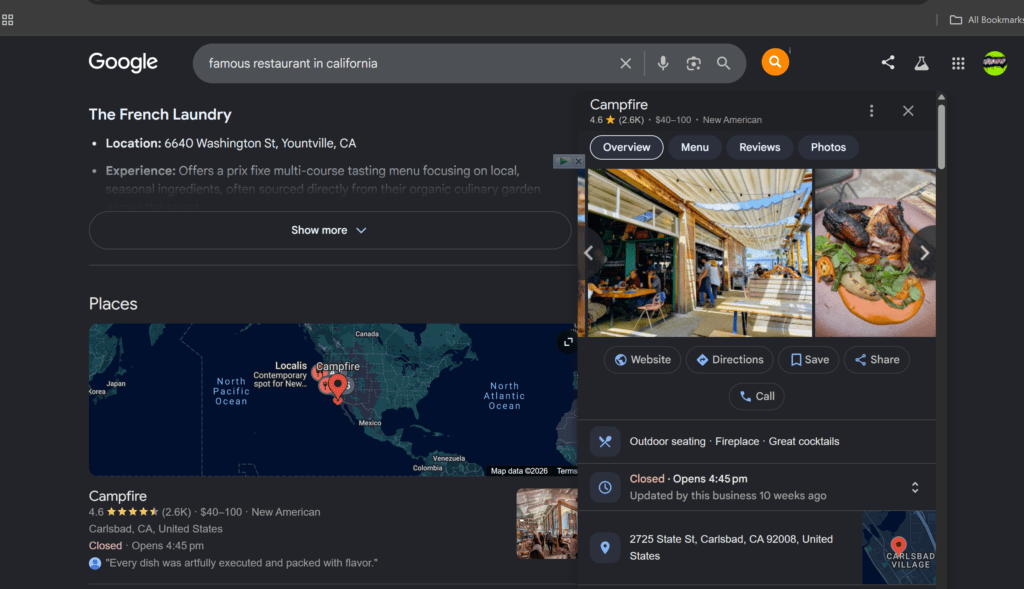
When someone searches for a specific brand name, known as a "branded search," or when Google determines that one brand best matches the searcher's needs, it usually displays a Google Business Profile alongside the regular search results.
Google Business Profiles are the primary way local businesses appear in Google's platform.
Local businesses that fulfill all the guidelines for presenting their business on Google can create a Google Business Profile at no cost.
2. Local packs
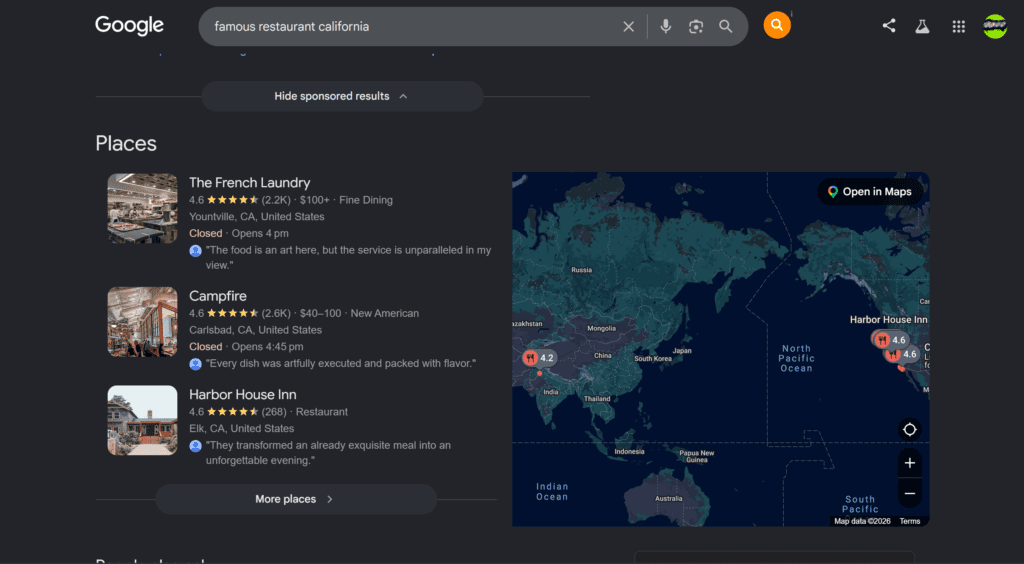
When Google determines that a user is looking for a variety of local results, it usually displays a feature known as the "local pack." The number of listings in the local pack can differ, but the most common number is three. In some cases, the local pack may also include paid advertisements.
There are several versions of the local pack, each emphasizing different aspects such as customer reviews, pricing details, contact numbers, website addresses, booking options, and other relevant information.
When the local pack is labeled "Places" (as shown above), selecting the "More places" link at the bottom usually directs users to the expanded local search results page on Google, known as the Local Finder. We'll cover the Local Finder in more detail next.
When the local pack is titled "Businesses" (as shown above) and includes a "More businesses" link, clicking it generally directs users to Google's Local Services Ads platform rather than the Local Finder. Only businesses enrolled in Google's Local Services Ads (LSA) program are eligible to appear in this type of local pack.
3. Google Maps
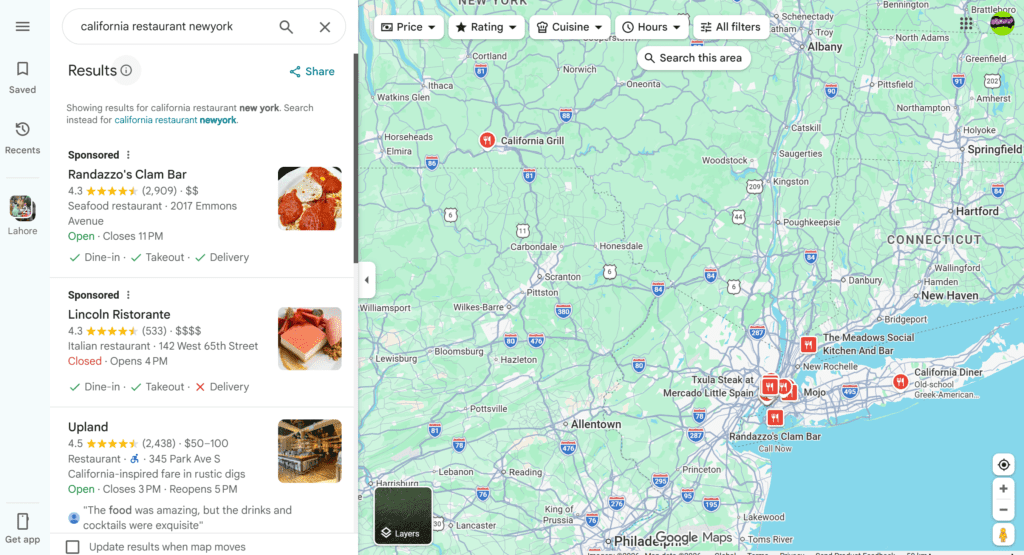
Users can also select the Maps tab at the top of Google's search results to view listings in Google Maps. While these results resemble those shown in the Local Finder, they are generated separately and may display businesses in a different ranking order. On Android smartphones and tablets, Google Maps is typically the default navigation application, making it a common way for users to discover local businesses.
4. Localized organic results

In addition to thethree local search features discussed above, Google also personalizes its organic search results whenever it detects local intent. These localized results can include website links, images, videos, shopping listings, business directories, social media content, and other multimedia elements that help users find relevant local information.
Google's Local Results Depend on the Searcher's Location
Understanding how Google personalizes local search results is essential for anyone learning local SEO. Google uses the searcher's physical location at the time of the search to determine which businesses and content appear in local results.
For example, someone searching from a city's downtown area may see different businesses than someone searching only a few blocks away or from the suburbs. You can easily observe this behavior by performing the same search while traveling through different parts of your city.
Because Google prioritizes the searcher's location, there is no permanent number one ranking for local searches. A business may rank first for one user while appearing lower for another user searching from a different location.
Instead of trying to rank first for every search, businesses should focus on increasing their visibility across all of the geographic areas they serve. A strong local SEO strategy helps businesses reach more nearby customers regardless of where they perform their searches.
Key Benefits of Local SEO
Local SEO has become an essential marketing strategy for businesses that want to attract customers within their local service areas.
It improves online visibility, increases local traffic, and helps businesses compete more effectively in nearby markets.
The following benefits explain why investing in local SEO delivers long-term value.
Increased Visibility in Local Search
Appearing prominently in Google's local and organic search results helps businesses attract more local customers. Better visibility increases website visits, phone calls, direction requests, and ultimately more sales.
Research shows that more than 99% of consumers read online reviews before visiting a local business. A strong online presence therefore plays an important role in influencing purchase decisions.
Google Business Profiles make it easy for customers to find contact information, business hours, directions, photos, videos, and customer reviews. These features help searchers evaluate businesses without leaving Google's search results.
Localized organic search results display valuable content that helps users discover businesses and learn more before making purchasing decisions.
These results may include website links, business directory listings, images, videos, social media profiles, and shopping results for local brands. These additional search features create more opportunities for businesses to attract potential customers.
Businesses that rank well for branded searches allow existing customers to quickly locate addresses, phone numbers, and driving directions. This convenience improves customer experience and encourages more visits.
Strong local rankings also help businesses appear for non-branded searches such as "chiropractor near me" or "pharmacy open now." These searches often generate qualified leads because users already intend to purchase products or services.
Customer Reviews Build Trust and Drive Sales
Online reviews serve as a powerful form of digital word-of-mouth marketing. Most consumers read reviews before choosing a local business, making positive feedback an important competitive advantage.
Google Business Profile reviews often appear directly within Google's Local Pack and Maps results. Positive ratings and detailed customer feedback encourage more people to choose your business over competing options.
Google calculates an overall star rating using every review submitted to a business profile. High ratings help customers quickly compare nearby businesses and identify trusted providers.
Businesses with consistently strong ratings often receive more clicks, calls, and store visits than competitors with lower review scores.
Reviews Provide Free Business Intelligence
Customer reviews offer valuable insights into business performance without requiring expensive market research. They help business owners understand customer expectations and identify opportunities for improvement.
Although some business owners worry about receiving negative reviews, responding professionally often improves customer trust and strengthens brand reputation.
Large companies spend significant amounts on customer research, while local businesses can obtain similar insights through online reviews. Customers frequently share honest opinions about product quality, service, pricing, and overall experience.
By analyzing this feedback, businesses can resolve recurring issues, improve customer service, and strengthen operational processes. This continuous feedback loop provides a valuable form of quality control.
Better Customer Retention
Acquiring new customers usually costs more than retaining existing ones. Responding thoughtfully to customer reviews helps businesses strengthen relationships and reduce customer turnover.
Studies have shown that approximately 73% of dissatisfied customers will consider giving a business another chance when the owner responds effectively and resolves their concerns. Recovering even a portion of unhappy customers can significantly improve long-term profitability.
A Competitive Advantage
Every local business competes with nearby companies that appear in Google's Local Pack, Local Finder, and Google Maps. Businesses that actively invest in local SEO often outperform competitors that neglect their online presence.
A comprehensive local SEO strategy improves visibility, attracts more qualified traffic, and strengthens brand authority within local markets. Businesses that consistently optimize their websites, Google Business Profiles, and online reputation usually gain a lasting competitive advantage.
With these benefits in mind, the next step is understanding the ranking factors that influence how Google orders businesses in the Local Pack, Local Finder, and Google Maps.
Local SEO ranking factors to know
Google provides its own documentation on how to improve your local ranking within its system.
Although Google keeps its algorithm confidential, local SEO experts have spent more than two decades analyzing search results to identify the factors that influence local rankings. Because Google frequently updates its search algorithm and local search results, several factors play a significant role in determining Local Pack rankings.
Proximity of the searcher to the business
As mentioned earlier, Google customizes local search results according to the searcher's location. Because of this, the business you are promoting has the best chance of being visible to customers who are closest to it.
Address
In addition to taking into account the proximity of a business, its physical address is also an important factor in local SEO.
A clear and accurate address helps Google understand the business's location and improves its chances of appearing in relevant local results.
for more informational news visit our blog