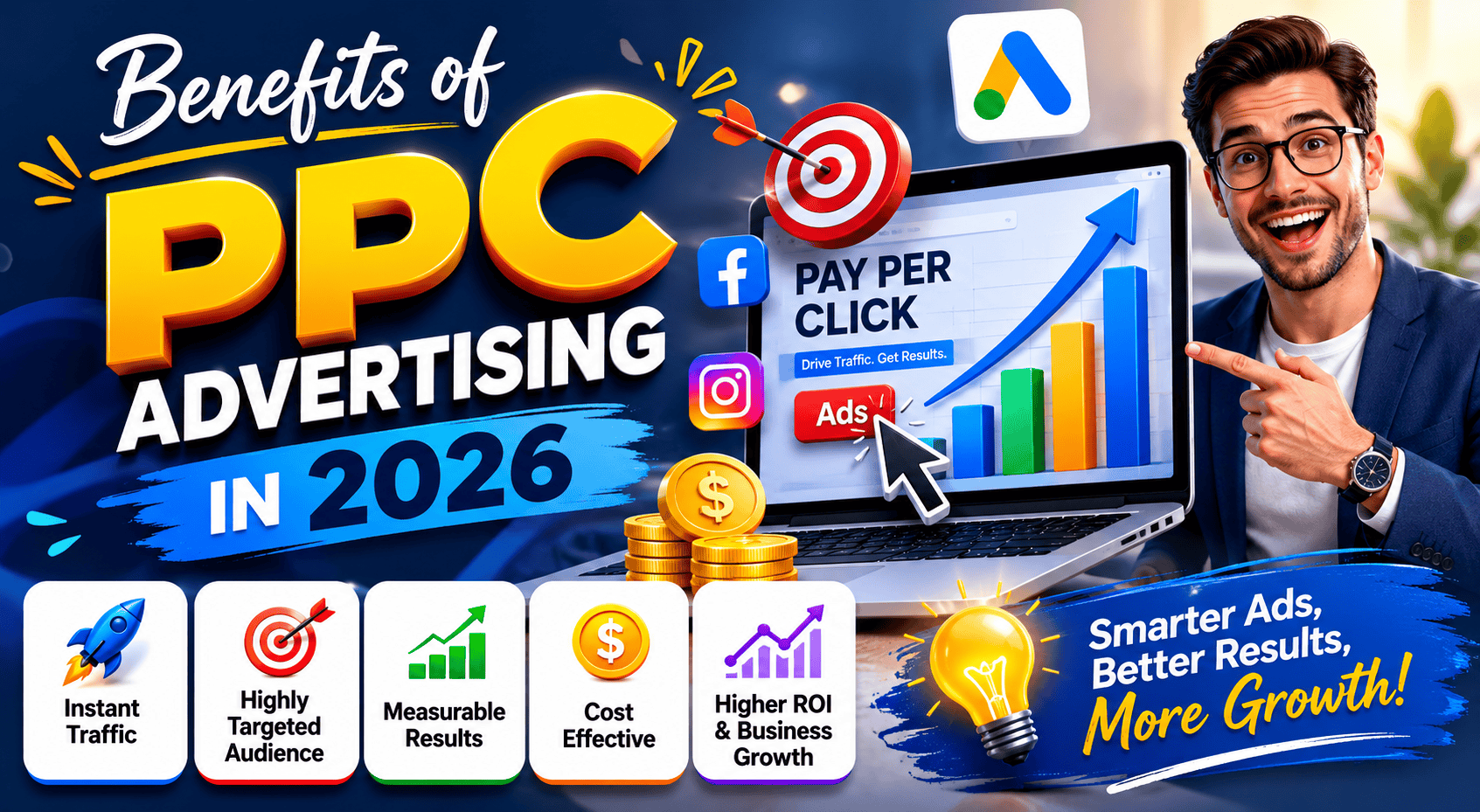
PPC advertising delivers immediate, measurable, and highly targeted results, allowing businesses to capture demand exactly when it occurs effectively.
Unlike long-term organic methods, PPC ensures quick traffic, high-intent leads, and real-time visibility across search engines and platforms.
This approach also extends reach across social platforms and display networks, improving brand exposure and audience engagement consistently over time.
Through precise audience targeting, flexible budget management, and performance tracking, businesses can continuously optimize campaigns for better outcomes.
These optimizations help improve conversion rates, while simultaneously enhancing overall brand presence and marketing efficiency across digital channels effectively.
Other major benefits of PPC advertising include instant results and traffic, accurate targeting, cost-effective budget control, measurable return on investment, and increased brand visibility.
PPC provides flexibility, supports SEO strategies through data-driven insights, and allows for remarketing to re-engage users. It also offers a competitive edge, mobile-first and localized reach, and scalable solutions that work for startups, small businesses, large enterprises, local businesses.
Across various service types—Search, Display, Social, and Remarketing—PPC drives growth by combining speed, scalability, and performance-based optimization.
This supports predictable revenue, lead generation, and actionable insights for businesses of all sizes and industries.
The following are the 12 benefits of PPC advertising in 2026:
Instant Results & Traffic
Unlike SEO strategies, which can take months, PPC advertising delivers immediate traffic and sales by appearing at the top of search results within minutes of campaign launch.
Rather than waiting for organic rankings to build authority, PPC lets businesses capture high-intent demand the moment users start looking for a solution, positioning their brand during crucial decision points on search engine results pages.
This speed-to-market allows for immediate visibility, helping businesses capture real-time demand and attract relevant traffic exactly when potential customers are ready to take action.
By maintaining prominent placement where relevance and intent meet, PPC ensures a steady flow of qualified visitors while giving businesses the operational agility to generate leads precisely when they are ready to convert.
Precision Targeted Reach
Regardless of the business type, PPC advertising provides precise audience targeting, allowing businesses to reach users based on search intent, relevance, demographics, location, and behavior.
This level of targeting ensures that pay-per-click campaigns connect with the right audience during active decision moments.
Instead of casting a wide net, pay-per-click advertising uses search intent and behavioral signals to control visibility, ensuring ads appear only to users actively seeking a solution.
For instance, a plumbing company can display paid search ads only to users searching for emergency plumbing services within a specific service area, ensuring the message reaches people who already need the solution.
This emphasis on accuracy over volume reduces wasted impressions and budgets while directing online advertising toward highly relevant audiences.
As a result, performance-based advertising attracts quality traffic, improves conversion potential, and supports measurable results across digital marketing efforts.
Cost-Efficient Budget Control
Pay-per-click advertising gives businesses full control over their advertising spend, allowing campaigns to scale, pause, or adjust based on performance signals.
Unlike outdated cost per impression (CPM) models, where you pay for every 1,000 impressions your ad receives, PPC only charges when those impressions result in link clicks.
PPC also supports budget allocation by aligning it with measurable results, helping businesses manage risk while maintaining consistent visibility within digital campaigns.
This control allows marketers to direct ad spend toward high-performing audiences, products, or services, while limiting exposure in underperforming areas. As a result, performance-based advertising supports controlled growth, protects marketing budgets, and allows businesses to refine their online strategies while maintaining predictable cost management.
Measurable & Trackable ROI
With PPC advertising, businesses see how ad spend translates into traffic, leads, and revenue through real-time performance data.
This transparency lets marketers track PPC campaign impact on user actions while controlling budgets and audience targeting precisely.
Campaign performance shows how specific ad spend levels generate measurable revenue clearly and consistently across different marketing channels effectively.
This allows businesses to assess the genuine value of their online advertising investment and optimize spending decisions more accurately overall.
Platforms like Google Ads and Microsoft
Advertising provides detailed performance insights through key metrics like Click-Through Rate, Cost Per Click, and Conversion Rate.
It also tracks Impressions, Cost Per Acquisition, Quality Score, and Ad Rank to measure overall campaign effectiveness accurately.
By maintaining this level of tracking, businesses can make informed decisions about where to allocate resources.
Enhanced Brand Visibility & Awareness
Beyond direct traffic, PPC advertising strengthens brand visibility by placing your business prominently across search results and digital platforms increasing awareness.
This prominent placement ensures your brand consistently appears in front of potential customers during active search and browsing activities online.
This increased visibility ensures that potential customers consistently see your brand during searches, boosting recognition and overall engagement effectively over time.
This visibility accelerates brand recognition even before users click an ad, establishing presence early in the customer journey.
With pay-per-click campaigns, your brand name, products, or services consistently appear in front of potential customers actively searching online solutions.
This repeated exposure increases the likelihood that users encounter your business multiple times throughout their search and evaluation journey.
This repeated exposure helps establish early brand recognition during high-intent research moments.
Even when users don’t click immediately, seeing the same brand across relevant searches reinforces familiarity and credibility.
As customers continue to explore related queries or digital content, this consistent visibility keeps the brand present throughout decision-making process.
This continuous exposure ensures that users repeatedly encounter the brand while comparing options across multiple search sessions and touchpoints online.
The combination of traffic and brand exposure helps capture immediate demand while building long-term recognition over time.
Businesses can gradually strengthen awareness so customers are more likely to take action when they reach final purchase decision stages.
Agile Flexibility & Speed
PPC advertising offers agile campaign flexibility for businesses to adjust campaigns quickly based on performance insights and market demand signals.
Unlike traditional media or long-term organic strategies, marketers can quickly change ad messaging to respond to evolving market conditions dynamically.
Marketers can shift budget allocation or promote specific products and services when performance signals reveal emerging opportunities in campaigns rapidly.
This responsiveness makes performance-based advertising highly adaptable in dynamic markets according to seasonal trends or internal business changes quickly efficiently.
Whether you need to focus on a specific service during a sudden demand surge or pull back during a transition.
PPC offers the tools to align your digital presence with your operational needs effectively across changing business conditions and environments.
SEO-Supporting Performance
PPC advertising supports SEO efforts by delivering immediate high-intent traffic and valuable keyword insights that strengthen broader digital marketing strategies.
Through pay-per-click campaigns, businesses can test keyword performance, evaluate ad messaging, and understand user search behavior for specific products services.
These campaigns also reveal which keywords generate engagement and how audiences interact with advertisements across different search queries in detail.
These insights help identify which search terms generate meaningful engagement, allowing marketers to refine content strategy effectively over time performance.
Marketers can then focus organic SEO efforts on high-conversion keywords discovered through continuous PPC campaign optimization and ongoing analysis process.
Running PPC ads alongside organic listings also increases brand visibility on search.