
What is the significance of seo
you’ve probably heard that Search Engine Optimization (SEO) is a key digital marketing strategy, but how does it actually work? SEO is the process of increasing website traffic through free, organic, editorial, or natural search engine results. It involves a combination of techniques and factors that help improve your site’s visibility in search rankings. By applying SEO effectively, you can significantly boost your website’s exposure.
AIOSEO reports the first Google result gets 27.6% CTR, with second at 18.7% and third at 10.2%.
This means that ranking on the first page—or ideally at the top—can drive substantially more traffic and increase your chances of converting visitors into customers. At the same time, artificial intelligence has added a new layer of complexity.
AI-driven systems such as Google’s RankBrain have transformed how search engines interpret and rank content, making the SEO landscape more dynamic and competitive than ever.
Let’s examine why SEO matters. It helps attract traffic, generate high-quality leads, and increase sales effectively.
We will also explore five essential elements that support stronger visibility and better search performance..
What are the advantages of using SEO?
Companies invest in SEO because it consistently delivers measurable results.
Let’s explore four key benefits of SEO and how it can significantly improve website traffic and lead generation.
1. SEO enhances online visibility and boosts search engine rankings
A key SEO goal is increasing visibility so potential customers can easily find your products or services in search results.
This visibility is closely tied to your search rankings.
Higher SERP rankings increase visibility and click-through rates to your website.
That’s why improving your organic ranking is so important.
For instance, a high-performing blog on agencomatic had previously dropped in rankings. After being refreshed with updated data and insights, it regained the top position on Google.
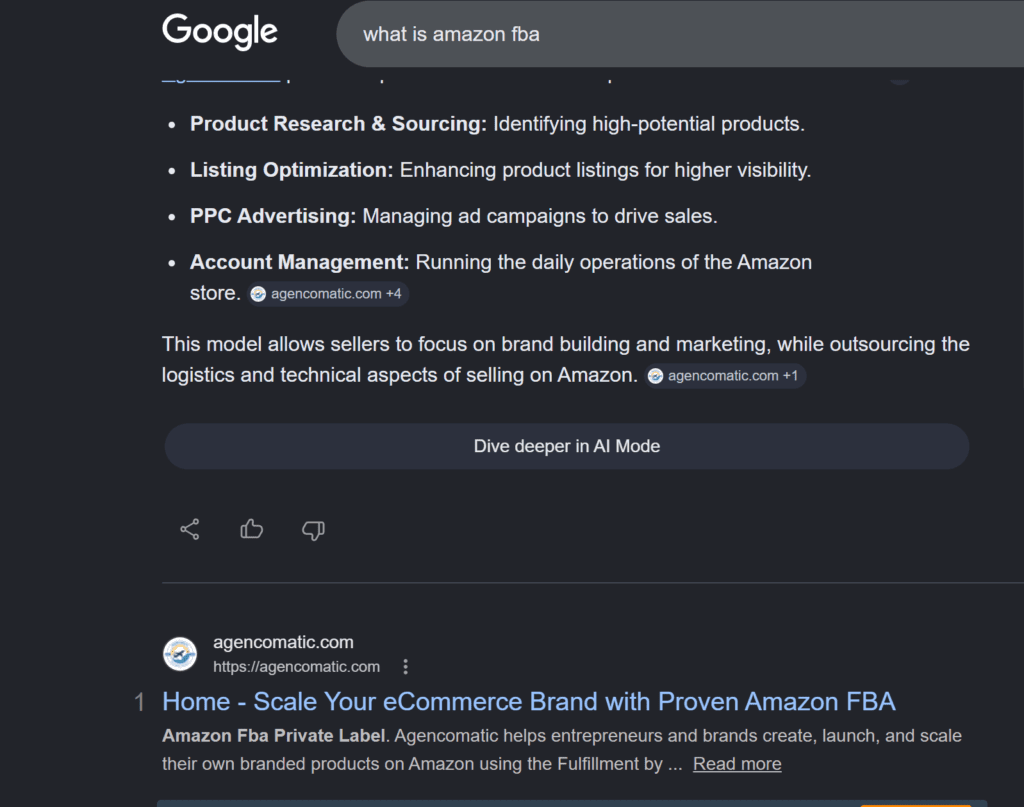
The more effective your SEO strategy, the higher your rankings and the greater your visibility—something that becomes even more critical given that around a quarter of users never go beyond the first page of search results.
2. SEO helps increase website traffic.
One of the primary objectives of SEO is to drive increased web traffic. The number one organic result on Google captures a disproportionately large share of clicks—often around 39.8%—and can generate up to 10 times more traffic than the result in the tenth position.
As highlighted by AIOSEO, securing the top ranking typically depends on high-quality content, alignment with search intent, and strong, relevant backlinks. In 2026, these top positions continue to serve as the primary drivers of search traffic. Therefore, as your ranking improves, your website typically receives more traffic.
Featured snippets are valuable because they appear at the top of search results, above organic listings (position #0).
It usually displays content pulled from a blog post or landing page that directly answers a user’s question. Below is an example of a Featured Snippet shown for a query such as “convert US size to UK size.”
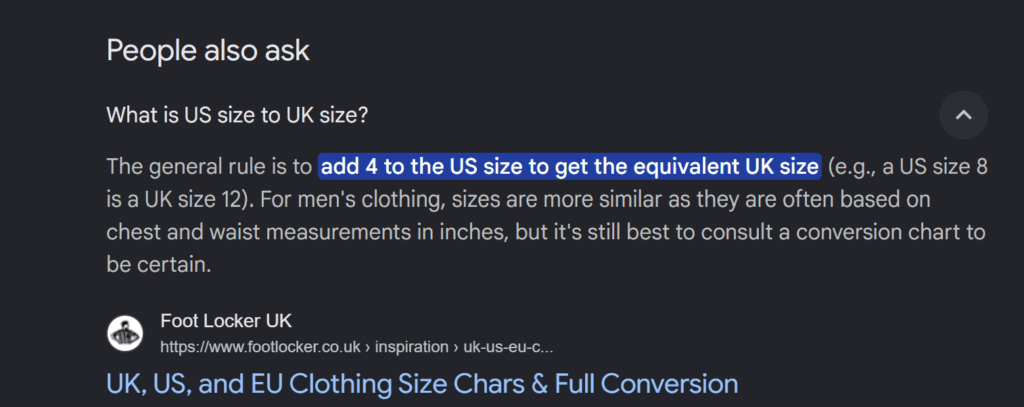
Securing a Featured Snippet can significantly increase your organic click-through rate. The main requirement is to create clear, helpful content that Google considers valuable enough to display as a snippet. To improve visibility in search engines, focus on SEO strategies that help your pages rank within the top five results, with the first position being the ultimate goal. For businesses seeking professional assistance in SEO, content marketing, and paid media, zohaib offers agency services in these areas.
3. SEO shows authority
Page Authority (PA) has become an increasingly relevant factor in search engine evaluation as user expectations for trustworthy and reliable content continue to grow. In simple terms, authority reflects how credible, high-quality, and relevant a website is, along with the value it provides to users. This concept aligns closely with Google’s E-E-A-T principles (Experience, Expertise, Authoritativeness, and Trustworthiness), which influence how content is assessed. PA is measured on a scale from 1 to 100, where higher scores indicate stronger authority. Tools like Moz can be used to check a website’s Page Authority score. Although improving PA can be challenging, SEO professionals generally recommend focusing on producing high-quality content, earning backlinks from reputable domains, and minimizing spam signals to strengthen overall authority.
4. SEO enhances the overall customer experience.
SEO is also essential because the effort invested in creating high-quality content and optimizing on-page elements improves your website’s usability. As a result, visitors enjoy a smoother and more engaging browsing experience.
For example, making your website responsive ensures that it functions properly across mobile phones, tablets, laptops, and desktop devices. Likewise, improving page loading speed helps reduce bounce rates and encourages users to stay on your site longer.
Today’s users expect websites to load within a few seconds. If a page takes too long to open, visitors are more likely to leave, which can negatively impact conversions and overall website performance.
4. SEO enhances the overall customer experience
SEO is also essential because the effort invested in creating high-quality content and optimizing on-page elements improves your website’s usability. As a result, visitors enjoy a smoother and more engaging browsing experience. For example, making your website responsive ensures that it functions properly across mobile phones, tablets, laptops, and desktop devices. Likewise, improving page loading speed helps reduce bounce rates and encourages users to stay on your site longer. Today’s users expect websites to load within a few seconds. Slow-loading pages increase bounce rates and reduce conversions and performance.
It is also important to evaluate the entire customer journey by analyzing every interaction a visitor has with your website. For instance, when someone clicks on a blog post from Google search results, consider where they land and what they experience first. Check whether the content is valuable, matches the user’s search intent, and is easy to read without unnecessary interruptions such as excessive pop-ups or distractions. Testing the journey yourself can help identify usability issues and weak points in the experience. If you encounter anything confusing or disruptive, visitors are likely to face the same problem.
What Are the 5 Crucial Elements of SEO?
1. Keywords
Keywords alone no longer define SEO success but remain a key part of modern optimization.
Keyword refer to the words and phrases people enter into search engines when they are seeking information, products, or services. For businesses and content creators, these search terms serve as a connection point between user intent and relevant online content. To achieve strong results from keyword usage in an SEO strategy, careful research is essential. Understanding what your audience is actively searching for allows you to identify the most relevant and high-impact terms. When applied thoughtfully across website pages and content, keywords can improve search visibility and help attract more targeted and valuable traffic from multiple digital channels.
KEYWORD RESEARCH
When conducting keyword research, it is important to identify terms that have strong search demand but relatively low competition.This balance increases the likelihood of ranking well while still attracting meaningful traffic.
Research has also shown that longer, more specific keywords tend to perform better; for instance, studies suggest that longer keyword phrases can generate significantly higher click-through rates compared to single-word terms.For example, your keyword strategy may include a mix of different types of search terms.A short-tail keyword might be something broad like “dog,” while a long-tail keyword could be more specific, such as “terrier puppies for sale.” You can also include local keywordslike “puppies for sale in Boston” to target users in a specific geographic area.In addition to a primary or seed keyword, it is also beneficial to incorporate secondary and tertiary keywords.These supporting terms help expand your content’s relevance and improve its chances of ranking for multiple related searches.
A key tip is to always consider search intent when selecting keywords.Understanding what users are truly looking for helps align your content with their needs and improves performance, especially as search engines continue to evolve with AI-driven algorithms.Analyzing the search queries that already bring users to your site can also help you develop new content ideas and refine your overall keyword strategy.
2. Content
Content plays a crucial role in SEO because it is the main medium through which you attract, inform, and engage your target audience. Having a clear perspective and producing content that aligns with user needs is essential for building visibility and authority in search results.
For example, if you operated a Computer store and aimed to improve your online presence, you could create a set of informative blog posts related to computer topics. These might include articles such as “how to choose a good computer” or “best budget gaming mouse in 2026.” Content like this not only provides value to readers but also helps your website rank for relevant search queries and potentially appear in featured snippets on search engines.
EXAMPLE

If users find your blog through computer tips, it builds trust and encourages them to return for more information.
Pro tip: Reviewing Google’s “People also ask” section can help you discover fresh content ideas related to your topic.
Creating a successful digital presence depends on producing content that delivers value, captures attention, matches audience interests, and encourages sharing. Businesses can publish content in many different forms, including: Website pages Dedicated landing pages Educational or promotional videos Blog posts Infographics Podcasts Online seminars and webinars Instructional guides Industry reports and whitepapers Digital books and ebooks Social media content Business directory and local listings Video plays a major role in modern SEO strategies because search engines often feature video results for searches that involve demonstrations or tutorials. For example, someone searching for “best budget gaming mouse in 2026” is likely to see video guides displayed prominently in search results. This highlights the importance of producing well-optimized video content to increase online visibility and user interaction.

Top tip: Don’t forget about YouTube for SEO. Check out ways to rank your videos using SEO on YouTube to drive traffic.
3. Off-Page SEO
Off-page SEO involves actions performed beyond your website to enhance its authority, visibility, and position in search engine results.
A major part of off-page SEO is earning backlinks from reputable websites. Links from trusted sites increase credibility and can improve search rankings.
Backlinks can be earned through guest posting, original research, guides, toolkits, and influencer collaborations.
These strategies help attract links naturally while increasing brand exposure. The quality of backlinks matters far more than the quantity. A single link from a highly respected source such as Forbes or The New York Times can provide significantly more SEO value than dozens of low-quality links from weak or unrelated websites.
Understanding the difference between on-page and off-page SEO helps you apply both effectively in a complete optimization strategy.
4. Local SEO
Local SEO is increasingly important as people use smartphones and voice assistants to find nearby businesses and services.
As mobile use and voice search grow, businesses must optimize their online presence for local search.
Most web traffic is mobile-based, and many users use voice search to find nearby products and services.
Customer reviews also play a major role in shaping public trust and influencing buying decisions for local businesses. For example, if you operate a restaurant, local SEO can help your business appear when people nearby search for phrases such as “best restaurants near me” or “top places to eat in town.”
Some effective local SEO strategies include: Using location-based keywords Keeping your business name, address, and phone number consistent online Claiming and optimizing your Google Business Profile Listing your business in local directories Encouraging customers to leave reviews Making sure your website works well on mobile devices Creating content focused on local topics and communities Earning backlinks from trusted local websites Promoting your business through social media engagement Optimizing content for voice search queries.
5. Search Engine Marketing
Search Engine Marketing (SEM) involves paid digital marketing strategies used to increase visibility on search engines and attract targeted audiences.
SEM and SEO are separate but can work together to strengthen overall marketing strategy.
Businesses continue to invest heavily in search advertising because it provides a direct way to reach potential customers who are actively searching for products or services online.
Combining paid campaigns with organic SEO efforts can help improve brand exposure and drive more traffic. For SEM campaigns to perform well, it is important to conduct keyword research, understand audience behavior, and design landing pages that closely align with the messaging used in advertisements. Well-optimized landing pages can improve both user experience and conversion rates. Common SEM strategies include: Pay-per-click (PPC) advertising Display and banner advertising Remarketing and retargeting campaigns Local search advertisements Shopping ads for e-commerce products Video advertising Native advertising Programmatic advertising Affiliate marketing campaigns Using both organic SEO and paid SEM techniques together can help businesses maximize online visibility and reach a broader audience more effectively.
What Impact is AI Having on Search and SEO?
Developments in artificial intelligence have allowed search engines to build far more sophisticated algorithms, leading to major changes in both search behavior and SEO practices. In the past, Google depended heavily on matching exact keywords.
Search engines now use semantic search to understand user intent, behavior, and context behind queries.
Google introduced RankBrain in 2015 to better connect words with broader concepts and improve the interpretation of search queries. Later, the company launched BERT, an AI-based language model capable of understanding how combinations of words change meaning and intent within a sentence. Google then expanded these capabilities further with MUM, a system designed to process and generate language more effectively across complex searches. More recently, Google introduced the Search Generative Experience (SGE), which uses artificial intelligence to provide richer and more detailed search results directly on the results page. These AI-generated responses are designed to deliver highly relevant information quickly, offering users more complete answers without requiring extensive searching.
EXAMPLE

To improve SEO performance in the age of AI-driven search engines, businesses need to adapt their strategies to focus on user intent, content quality, and overall experience rather than relying only on traditional keyword optimization.
Some effective ways to optimize SEO for AI-powered search include: Prioritizing search intent instead of focusing solely on keywords Creating topic-focused content that answers user questions in depth Producing multiple content formats such as blogs, videos, podcasts, and webinars to reach wider audiences Applying Google’s E-E-A-T principles by demonstrating experience, expertise, authority, and trustworthiness Optimizing content for voice search by using more natural and conversational language Maintaining strong technical SEO practices, including site speed, internal linking, keyword optimization, and backlink building Delivering a smooth and user-friendly website experience across all devices Keeping messaging and content consistent across websites, social media, and other digital channels As AI continues to reshape search engines, successful SEO strategies will increasingly depend on relevance, usability, and high-quality content that genuinely meets user needs.
Conclusion: Search Engines Are Fallible
SEO plays a crucial role because search engines are not flawless systems. Without proper optimization, a website may not perform well or may even be overlooked entirely in search results.
Without proper internal linking, search engines may fail to crawl and index pages correctly, reducing overall search rankings.
Technical errors can block search engines from accessing a site, preventing it from appearing in results even with strong content.
Search engines can also face challenges with certain types of content.
such as: Duplicate or repeated content across pages, Content inside forms that is not easily accessible, Images, audio, video, and other non-text elements without proper optimization, Complex language usage and semantic interpretation.
To solve these issues, you should understand SEO fundamentals and create content that matches user intent.
By doing so, websites can improve visibility, attract relevant traffic, and provide more value to searchers.
Use SEO to Drive Traffic & Generate Quality Leads
Combining SEO and paid search helps reach people actively searching for your products or services.
However, success depends on understanding how to apply these methods effectively and strategically. A structured learning approach can help build strong foundational knowledge in search marketing.
with search marketing you can do SEO, paid advertising, demand generation, search analytics, and overall search strategy. Developing these skills enables marketers to improve visibility, attract relevant traffic, and create more effective digital campaigns.